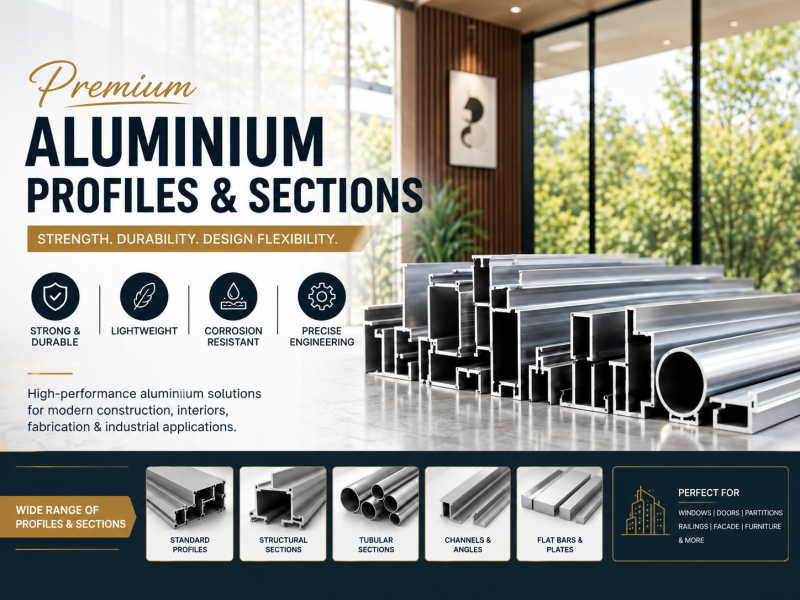
Aluminium profiles and sections are widely used in construction, architecture, interior design, fabrication, manufacturing and engineering applications. From doors and windows to partitions, furniture, railings and structural frameworks, aluminium sections provide a practical combination of strength, lightweight construction and design flexibility.
With different shapes, sizes, thicknesses and finishes available, selecting the right aluminium profile can sometimes be difficult. This is where an experienced aluminium profile supplier in Delhi can help customers identify products according to their application, dimensions and project requirements.
Whether you are a builder, contractor, architect, fabricator, manufacturer or individual buyer, understanding the different types of aluminium profiles and sections can help you make a better purchasing decision.
What Are Aluminium Profiles and Sections?
Aluminium profiles are aluminium products manufactured into specific cross-sectional shapes. These shapes are designed to perform particular functions in construction, fabrication, furniture, industrial and architectural applications.
Depending on their design, aluminium profiles can be used as:
- Door and window frames
- Partition framing
- Railing components
- Furniture sections
- Structural frameworks
- Facade systems
- Curtain wall components
- Industrial frames
- Architectural structures
- Fabrication components
An aluminium section supplier in Delhi may offer standard sections as well as products intended for specific applications.
The appropriate section depends on factors such as required strength, dimensions, load, appearance, installation method and intended use.
Why Are Aluminium Profiles Popular?
Aluminium profiles have become popular across multiple industries because aluminium offers several useful characteristics.
1. Lightweight
Aluminium is considerably lighter than many conventional structural metals. This makes it easier to handle, transport and fabricate for many applications.
2. Strength and Durability
When the appropriate alloy and profile design are selected, aluminium can provide good strength for architectural, construction and fabrication applications.
3. Corrosion Resistance
Aluminium naturally forms a protective oxide layer, which helps it resist corrosion. This makes it suitable for many indoor and outdoor applications.
4. Design Flexibility
Aluminium can be manufactured into a wide range of shapes and profiles. This allows designers and fabricators to select sections according to the requirements of a project.
5. Low Maintenance
Many aluminium applications require relatively little maintenance, particularly when the correct finish and installation are used.
Common Types of Aluminium Profiles and Sections
Different projects require different aluminium shapes. Some of the commonly used categories include:
1. Aluminium Door Sections
Aluminium door sections are designed for manufacturing and installing aluminium doors. They can be used in residential buildings, offices, commercial spaces, shops and institutional projects.
When looking for an Aluminium Door Section in Delhi, consider:
- Door dimensions
- Profile thickness
- Glass or panel compatibility
- Required finish
- Door design
- Hardware compatibility
- Installation requirements
The correct door section can contribute to the strength, functionality and overall appearance of the finished door system.
2. Aluminium Window Sections
Aluminium window profiles are commonly used for manufacturing frames for sliding, fixed, casement and other window designs.
They can be combined with glass and suitable hardware to create functional window systems for residential and commercial buildings.
The choice of profile depends on the window configuration, dimensions, glass requirements and desired appearance.
3. Aluminium Partition Sections
Aluminium sections are frequently used in office and commercial partition systems. They can be combined with glass, panels or other materials to create internal partitions.
These profiles are useful for:
- Office cabins
- Meeting rooms
- Reception areas
- Workspaces
- Showrooms
- Commercial interiors
The lightweight nature of aluminium makes it convenient for creating partition frameworks while maintaining a clean appearance.
4. Aluminium Railing Profiles
Aluminium profiles are also used in railing systems for balconies, staircases, terraces and other areas.
Depending on the design, aluminium profiles can be used with glass, metal components or other infill materials.
For projects requiring glass railings, the profile needs to be selected according to the glass dimensions, fixing method, design and applicable safety requirements.
5. Aluminium Structural Profiles
Structural and framework profiles can be used for fabrication, industrial structures, architectural frameworks and other applications where a specific cross-sectional design is required.
The section should be selected according to the intended load, dimensions, span and structural requirements rather than simply choosing a profile based on appearance.
Aluminium Flat: Uses and Applications
An Aluminium Flat is a flat aluminium section commonly used in fabrication, engineering, construction and general manufacturing applications.
Aluminium flats are available in different widths and thicknesses, depending on the supplier and application.
They can be used for:
- Fabrication work
- Brackets and supports
- Frames
- Engineering applications
- General manufacturing
- Architectural fabrication
- Repair and maintenance work
When purchasing aluminium flat products, buyers should confirm the required width, thickness, length, alloy and finish.
Aluminium Rod: What You Need to Know
An Alumium Rod, commonly searched as aluminium rod, is a solid cylindrical aluminium product used in different fabrication, engineering and manufacturing applications.
Aluminium rods may be selected for applications requiring a lightweight solid metal section.
Before ordering aluminium rods, it is important to specify:
- Diameter
- Length
- Alloy or grade
- Quantity
- Required finish
- Intended application
Since specifications and availability can vary, discussing the exact requirements with an experienced supplier can help ensure that the appropriate material is sourced.
How to Choose the Right Aluminium Profile
Choosing an aluminium profile should start with the application rather than the price alone.
1. Identify the Application
First determine where the profile will be used.
A door profile, railing section, partition profile and industrial section can have very different designs and requirements.
2. Check Dimensions
The profile dimensions should match the project drawings or fabrication requirements.
Check measurements such as:
- Width
- Height
- Wall thickness
- Length
- Cross-sectional dimensions
For customised projects, providing technical drawings or accurate measurements can make product selection easier.
3. Consider the Required Strength
Not every aluminium profile is suitable for every load or structural requirement.
For applications involving significant loads, spans or structural performance, the profile should be selected based on appropriate engineering calculations and specifications.
4. Select the Right Finish
Aluminium profiles are available with different surface finishes depending on the application and supplier.
Common considerations include:
- Natural aluminium finish
- Anodised finish
- Powder-coated finish
- Other project-specific finishes
The choice should consider both appearance and environmental exposure.
5. Check Compatibility With Other Components
For aluminium doors, windows, partitions and railing systems, the profile must work correctly with associated glass, hardware, fasteners and other components.
Compatibility should be confirmed before ordering large quantities.
What to Ask an Aluminium Profile Supplier in Delhi
Before purchasing aluminium profiles, buyers should provide the supplier with as much information as possible about the project.
Useful details include:
- Product type
- Profile dimensions
- Required alloy or grade
- Thickness
- Quantity
- Surface finish
- Application
- Required delivery timeline
An experienced aluminium profile supplier in Delhi can then help identify suitable products based on these requirements.
For larger projects, it is also useful to confirm stock availability and lead times before finalising the order.
Aluminium Profiles for Construction and Architecture
The construction and architecture sectors use aluminium profiles for a wide range of applications.
They can be incorporated into:
- Doors
- Windows
- Railings
- Partitions
- Curtain walls
- Facades
- Louvers
- Pergolas
- Interior systems
- Architectural frameworks
The popularity of aluminium in modern architecture is partly due to its combination of lightweight construction, versatility and contemporary appearance.
Aluminium Sections for Fabrication and Industrial Applications
Aluminium sections are also useful for fabricators and manufacturers who require lightweight metal components.
Depending on the profile design, they can be used to create frames, supports, enclosures, machine structures, furniture components and other fabricated products.
For industrial requirements, factors such as alloy, strength, dimensional tolerance and application-specific specifications become particularly important.
Why Work With an Experienced Aluminium Section Supplier?
Buying aluminium profiles is not simply about finding a product with the right shape. The material must also be suitable for its intended application.
An experienced supplier can help with:
- Product identification
- Profile selection
- Product specifications
- Quantity requirements
- Stock availability
- Sourcing of required sections
- Finish selection
- Project-specific requirements
This can be particularly useful when a project requires multiple aluminium products or non-standard specifications.
Aluminium Profiles and Sections from Kohli Aluminium
Kohli Aluminium has been involved in aluminium trading and the sourcing, supply and distribution of aluminium products since 1994.
The company caters to customers across construction, transportation, electrical, aeronautical, food and beverage and other industries.
Its product-focused approach includes helping customers with product selection and requirements for different applications. Quality assurance and product checking are also part of the supply process before dispatch.
From aluminium profiles and door sections to sheets, tubes, flats, rods and other aluminium products, customers can discuss their specific requirements to identify suitable material for their projects.
Frequently Asked Questions About Aluminium Profiles
Q1. What is an aluminium profile?
Ans. An aluminium profile is an aluminium product manufactured into a specific cross-sectional shape for a particular application. Profiles are widely used in construction, architecture, furniture, fabrication and industrial applications.
Q2. Where can aluminium profiles be used?
Ans. Aluminium profiles can be used for doors, windows, partitions, railings, facades, curtain walls, furniture, industrial frameworks, pergolas, louvers and various fabrication applications.
Q3. How do I choose an aluminium profile?
Ans. Choose a profile based on its intended application, dimensions, required strength, finish, compatibility with other components and project specifications.
Q4. What is an aluminium door section?
Ans. An aluminium door section is a specially designed aluminium profile used to fabricate door frames and related components. Different sections may be used depending on the door design, dimensions, glass or panel configuration and hardware.
Q5. What is an aluminium flat used for?
Ans. Aluminium flats are commonly used in fabrication, engineering, construction and manufacturing applications where a flat aluminium section is required.
Q6. What is an aluminium rod?
Ans. An aluminium rod is a solid cylindrical aluminium product available in different diameters, lengths and material specifications. It can be used for various fabrication, engineering and manufacturing applications.
Q7. Can aluminium profiles be customised?
Ans. Certain aluminium profiles can be customised or sourced according to project-specific requirements, depending on the design, quantity and manufacturing possibilities. Discussing drawings and specifications with the supplier is recommended.
Q8. How do I find an aluminium section supplier in Delhi?
Ans. Look for a supplier with a broad product range, reliable sourcing capabilities, clear product specifications and experience serving construction, fabrication or industrial requirements. Providing the exact profile dimensions and intended application can help the supplier recommend a suitable section.
Conclusion
Aluminium profiles and sections are essential components in modern construction, architecture, fabrication and industrial applications. Their lightweight nature, versatility, durability and range of available designs make them suitable for numerous projects.
Whether you require door sections, window profiles, partition sections, railing profiles, aluminium flats, rods or specialised sections, the right product should always be selected according to the project's technical and application requirements.
If you are searching for an aluminium profile supplier in Delhi or an aluminium section supplier in Delhi, compare product specifications, availability, quality, finish and supplier experience before making your purchase.
For project-specific requirements, providing accurate dimensions, quantities and application details can help ensure that you receive the right aluminium profile or section for the job.